
It started with a tired arm and a simple thought: “There’s got to be a better way.”
In 2013, Robert Dahlstrom found himself standing on a ladder, perched atop scaffolding, putting a fresh coat of paint on his beach house at Cape San Blas, Florida. He had painted houses decades earlier to help put himself through college. But now the risk felt different: his arm was tired, his neck ached, and the ground looked a long way down.
“I quickly realized I’m not in college anymore,” Dahlstrom recalled. “There’s got to be a better way, and I thought—drones.” [1]
The idea immediately ran into physics. Paint is heavy, and batteries last minutes rather than hours. The payload math did not work: a conventional drone would need to land repeatedly to refill paint and replace batteries. Then Dahlstrom looked down.
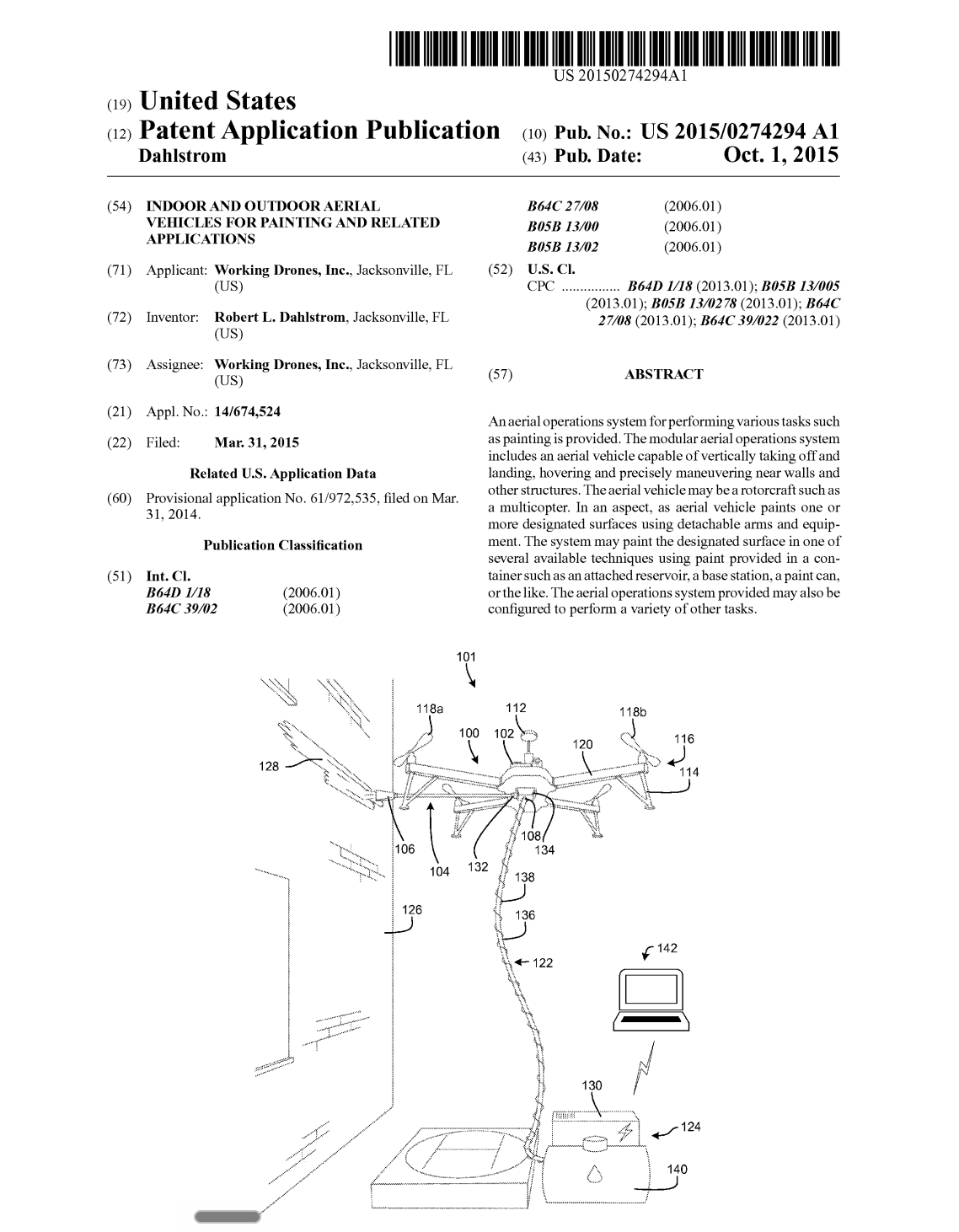
“I look down at the ground and there’s the paint compressor,” he said. “Keep the paint on the ground, the power on the ground, send it all up the cord to the drone and then spray paint.” [2]
That was the breakthrough: keep heavy equipment on the ground; move coating material through a tether; and use software-controlled flight to maintain the required distance, angle, and speed. Dahlstrom built an early proof of concept in his Jacksonville garage, pursued patents, and founded the company that became Apellix. [3]
Over the following decade, the concept evolved into a category of aerial robotics intended to do physical work rather than only collect imagery or data.
The Working-Drone Concept
When Dahlstrom incorporated Working Drones Inc. in 2014—later operating under the Apellix brand—the commercial drone sector was largely associated with imaging, thermal sensing, and surveying. Dahlstrom proposed a different application: drones equipped with end effectors that could clean, coat, or measure surfaces. [3]
Apellix uses the term “Working Drones” for aerial robotic systems equipped with tools such as spray guns, pressure-wash nozzles, and non-destructive-testing sensors. The company’s public descriptions frame these systems as tools for changing or interacting with a surface rather than simply observing it. Independent trade coverage likewise describes Apellix systems used for power washing, painting, coating, cleaning, and NDT. [4][5]
Press and event materials have described Dahlstrom as the “Father of Working Drones,” although that is a promotional or editorial characterization rather than a formal title. [5][6]
Dahlstrom’s issued patents describe tethered aerial-vehicle, ground-station, painting, sensing, and control concepts relevant to this work. Patent records are the primary source for the scope of the claimed inventions. [7][8][9]
Seven Patents
Apellix aerial robotics portfolio includes seven granted U.S. patents, with additional applications pending. The individual patent records should be used as the authoritative sources for patent titles, inventors, assignees, and claims. [7][8][9][10][11][12][13]
- US 9,611,038 — Mobile Computing Device-based Guidance Navigation and Control for Unmanned Aerial Vehicles and Robotic Systems. Priority date: 2014 [7]
- US 10,011,352 — Mobile Base Station and Umbilical Cabling and Tethering (UCAT) Assist System. Priority date: 2014 [8]
- US 10,195,629 — System, Mobile Base Station, and Umbilical Cabling and Tethering (UCAT) Apparatus. Priority date: 2014 [9]
- US 10,399,676 — Indoor and Outdoor Aerial Vehicles for Painting and Related Applications. This patent describes, among other elements, an unmanned aerial vehicle with a sprayer, a base station containing a material supply and power supply, and a tether linking the two. Priority date: 2015 [10]
- US 11,167,847 — Indoor and Outdoor Aerial Vehicles for Painting and Related Applications. Priority date: 2015 [11]
- US 11,235,890 — Unmanned Aerial Vehicle Having an Elevated Surface Sensor. Priority date: 2017. [12]
- US 12,202,635 — Methods for Using Tethered Unmanned Aerial Vehicle Having at Least One Task Sensor. Priority date: 2017. [13]
The Safety Problem
Dahlstrom’s Working Drones applications are rooted in a well-documented safety problem. Falls are the leading cause of death in construction, according to OSHA. The Bureau of Labor Statistics reported 389 fatal falls to a lower level among 1,034 construction fatalities in 2024; in 2023, construction accounted for nearly 48 percent of fatal falls, slips, and trips across U.S. industries. [14][15]
Relevant construction-fall statistics include:
- In 2023, 423 construction workers died from falls, slips, and trips—38.5 percent of construction fatalities. [15]
- CDC materials report that ladders account for 24 percent of fall deaths in construction. [16]
- CDC materials also report that 55 percent of fatal falls occur from 20 feet or less and that roofs, ladders, and scaffolds together account for nearly 72 percent of fall fatalities. [17]
- NIOSH states that construction workers have experienced approximately 300 fatal and 20,000 nonfatal fall-related injuries annually since 2013. [18]
Dahlstrom has cited a conversation with a member of the International Window Cleaners Association as reinforcing the safety mission: moving workers away from hazardous heights and toxic environments while keeping human operators on the ground. [19]
Power Washing Drones
Apellix’s Power & Soft Wash Drone is a tethered, heavy-lift aerial cleaning system connected to ground-based equipment. Product materials list up to 4,000 PSI, up to 11 gallons per minute, and a maximum working height of up to 195 feet, depending on model and configuration. Independent product coverage reports comparable specifications. [20][21][22]
The system’s design keeps pumps and fluid supplies on the ground while the aircraft carries the aerial tool. Trade coverage describes Apellix’s systems as aerial robotics intended to improve the safety and efficiency of high-risk cleaning tasks. [4][21]
These systems can be between 10 and 100 times faster than traditional methods utilizing lifts or cranes. [23]
Painting and Corrosion Control
Corrosion has substantial economic consequences. The NACE IMPACT study estimated the global annual cost at approximately $2.5 trillion, or about 3.4 percent of global GDP, and estimated that implementing currently available corrosion-control practices could yield savings of 15–35 percent. [24][25]
Apellix’s Spray Painting Drone is described by the company and industry coverage as a semi-autonomous aerial coating platform designed to manage standoff distance, speed, and alignment while applying coatings at height. Product performance—including throughput, working height, pressure, coating compatibility, and application quality—can be significantly better than traditional methods. [26][27]
The intended workflow is sequential: clean a surface, apply a protective coating, and use NDT tools to inspect or measure it. Independent coverage confirms that Apellix has presented drone-based NDT applications, including ultrasonic testing and dry-film-thickness measurement. [28]
ROI Claims
The principal economic rationale is the potential to reduce access-equipment needs, setup time, labor exposure, downtime, and rework. NCMS describes Apellix as an aerial-robotics company addressing high-risk tasks such as washing and coating; and that exact cost, schedule, productivity, and savings outcomes are job-specific. [4]
Autonomous Decontamination
Apellix’s work also extends to CBRN (Chemical, Biological, Radiological, and Nuclear) decontamination. Independent reporting in 2023 described the company’s participation in the U.S. Army Accelerator for Innovative Minds program and the use of its spraying technology to reduce personnel exposure during decontamination. [29]
NCMS reported in 2026 that Apellix had partnered with the U.S. Department of War on autonomous CBRN decontamination drones designed to neutralize chemical and biological threats while reducing warfighter exposure. [4]
More detailed statements in the earlier draft—such as the specific late-2025 Dugway demonstration sequence, a 10-hour-to-10-minute reduction, 1,000-plus-gallon-to-50–150-gallon water reductions, international demonstrations, and the “Apellix Breathe” program—demonstrate the progress being made in this area. [29][30]
The U.S. Army has publicly discussed autonomous systems for CBRN defense and requirements for robotic decontamination capabilities, including pre-washing, mapping contamination, applying decontaminants, and using sensors to assess cleanup. [31][32]
Robert Dahlstrom’s early tethered aerial-tool concepts, patent portfolio, and founding of Working Drones Inc.—DBA Apellix—created the foundation for what is known today as the working-drone category. He transformed the drone from a flying camera into an autonomous aerial work tool.
Endnotes
[1] Jacksonville Daily Record, “Robert Dahlstrom: Trip up a ladder leads to drone epiphany,” https://www.jaxdailyrecord.com/news/2022/mar/24/robert-dahlstrom-trip-up-a-ladder-leads-to-drone-epiphany/. Retrieved August 23, 2026.
[2] CoatingsPro Magazine, “Podcast Transcript: How Drones Are Lifting Corrosion Coating Inspections,” https://coatingspromag.com/industry-news/2021/03/podcast-transcript-how-drones-are-lifting-corrosion-coating-inspections. Retrieved August 23, 2026.
[3] Business Insider, “This drone can paint homes and de-ice airplanes,” https://www.businessinsider.com/apellix-drone-can-paint-homes-and-de-ice-airplanes-2016-3; Inside Unmanned Systems, “Air Brushed: New Drones Make Painting Easier,” https://insideunmannedsystems.com/air-brushed-new-drones-make-painting-easier/. Retrieved August 23, 2026.
[4] National Center for Manufacturing Sciences (NCMS), “Apellix – Member Spotlight,” March 4, 2026, https://ncms.org/news/apellix-member-spotlight/. Retrieved August 23, 2026.
[5] DRONELIFE, “Apellix on the Drone Radio Show Podcast: Robotics Platforms for Painting, Coating, Cleaning and More,” April 28, 2023, https://dronelife.com/2023/04/28/apellix-on-the-drone-radio-show-podcast-robotics-platforms-for-painting-coating-cleaning-and-more/. Retrieved August 23, 2026.
[6] The Workplace Event, “Robert Dahlstrom,” https://www.theworkplaceevent.com/speakers/robert-dahlstrom. Retrieved August 23, 2026.
[7] Google Patents, US 9,611,038, “Mobile Computing Device-based Guidance Navigation and Control for Unmanned Aerial Vehicles and Robotic Systems,” https://patents.google.com/patent/US9611038B2/en. Retrieved August 23, 2026.
[8] Google Patents, US 10,011,352, “Mobile Base Station and Umbilical Cabling and Tethering (UCAT) Assist System,” https://patents.google.com/patent/US10011352B2/en. Retrieved August 23, 2026.
[9] Google Patents, US 10,195,629, “System, Mobile Base Station, and Umbilical Cabling and Tethering (UCAT) Apparatus,” https://patents.google.com/patent/US10195629B2/en. Retrieved August 23, 2026.
[10] Google Patents, US 10,399,676, “Indoor and Outdoor Aerial Vehicles for Painting and Related Applications,” https://patents.google.com/patent/US10399676B2/en. Retrieved August 23, 2026.
[11] Google Patents, US 11,167,847, “Indoor and Outdoor Aerial Vehicles for Painting and Related Applications,” https://patents.google.com/patent/US11167847B2/en. Retrieved August 23, 2026.
[12] Google Patents, US 11,235,890, “Unmanned Aerial Vehicle Having an Elevated Surface Sensor,” https://patents.google.com/patent/US11235890B2/en. Retrieved August 23, 2026.
[13] Google Patents, US 12,202,635, “Methods for Using Tethered Unmanned Aerial Vehicle Having at Least One Task Sensor,” https://patents.google.com/patent/US12202635B2/en. Retrieved August 23, 2026.
[14] Occupational Safety and Health Administration, “Fall Prevention,” https://www.osha.gov/stop-falls. Retrieved August 23, 2026.
[15] U.S. Bureau of Labor Statistics, “Fatal falls in the construction industry in 2023,” https://www.bls.gov/opub/ted/2025/fatal-falls-in-the-construction-industry-in-2023.htm. Retrieved August 23, 2026.
[16] Centers for Disease Control and Prevention, “Construction Ladder Safety Month,” https://stacks.cdc.gov/view/cdc/151061. Retrieved August 23, 2026.
[17] Centers for Disease Control and Prevention, “Preventing Falls in Construction,” https://stacks.cdc.gov/view/cdc/157895/cdc_157895_DS1.pdf. Retrieved August 23, 2026.
[18] National Institute for Occupational Safety and Health, “Preventing Falls in Construction,” https://www.cdc.gov/niosh/bulletin/2024/construction-falls.html. Retrieved August 23, 2026.
[19] GrowFL, “Apellix: Innovation Born from Experience,” December 4, 2025, https://growfl.com/apellix/. Retrieved August 23, 2026.
[20] Commercial UAV News, “The Best Cleaning Drones on the Market Today: A Complete Buyer’s Guide—Apellix,” July 20, 2026, https://www.commercialuavnews.com/the-best-cleaning-drones-on-the-market-today--a-complete-buyer-s-guide-apellix. Retrieved August 23, 2026.
[21] Inspenet, “Apellix pressure washing drone: efficiency and safety,” May 5, 2025, https://inspenet.com/en/inspenet-tv/pressure-washing-drone-apellix-tanks/. Retrieved August 23, 2026.
[22] Technology Catalogue, “Apellix Power & Soft Wash Drone,” April 14, 2026, https://www.technologycatalogue.com/product_service/apellix-power-soft-wash-drone. Retrieved August 23, 2026.
[23] Apellix, “Industries,” https://apellix.com/industries/. Retrieved August 23, 2026. (Vendor-reported performance claim.)
[24] NACE International, “International Measures of Prevention, Application, and Economics of Corrosion Technologies (IMPACT),” https://impact.nace.org/economic-impact.aspx. Retrieved August 23, 2026.
[25] NACE International, “IMPACT Study Summary and Supplement,” https://impact.nace.org/documents/summary-supplement.pdf. Retrieved August 23, 2026.
[26] ProCoatTec, “Apellix,” https://procoattec.com/apellix/. Retrieved August 23, 2026.
[27] DRONELIFE, “Apellix Launches New Beta Program for Spray Painting Drone,” September 16, 2025, https://dronelife.com/2025/09/16/apellix-launches-new-beta-program-for-spray-painting-drone/. Retrieved August 23, 2026.
[28] e-verse, “Drone Technology: Elevating Safety and Precision in AEC,” October 15, 2024, https://e-verse.com/learn/custom-designed-drones-elevating-safety-and-efficiency-in-industrial-applications/. Retrieved August 23, 2026.
[29] The Drone Girl, “Apellix’s spraying drones: The future of CBRN decontamination?” December 12, 2023, https://www.thedronegirl.com/2023/12/12/apellix-spraying-drones/. Retrieved August 23, 2026.
[30] Construction in Focus, “Smarter, Safer Cleaning,” December 16, 2024, https://constructioninfocus.com/2024/12/smarter-safer-cleaning/. Retrieved August 23, 2026.
[31] Military Times, “The US Army is seeking autonomous drones to clean up chemical weapons,” February 3, 2026, https://www.militarytimes.com/news/your-military/2026/02/03/the-us-army-is-seeking-autonomous-drones-to-clean-up-chemical-weapons/. Retrieved August 23, 2026.
[32] U.S. Army, “Autonomy in Action: Advancing CBRN Defense Capabilities with Unmanned Systems,” https://www.army.mil/article/289761/autonomy_in_action_advancing_cbrn_defense_capabilities_with_unmanned_systems. Retrieved August 23, 2026.