Executive Summary
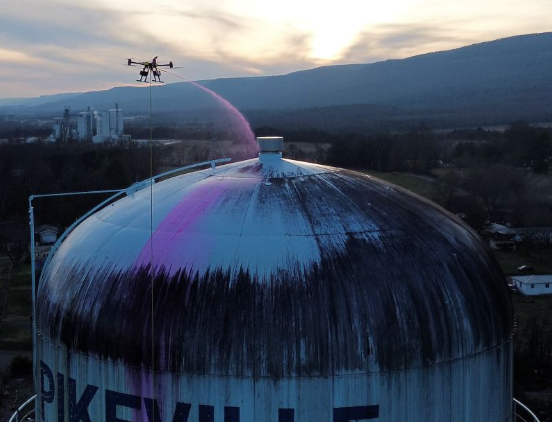
In Wooster, Ohio, an Apellix tethered Power Wash drone and a traditional lift crew cleaned the same elevated water tower on the same day — one half each. The results made the comparison simple:
The Apellix drone cleaned its half of the 115-foot tower in 2.5 hours, in a single flight, with the operator standing safely on the ground. The crew working from a 135-foot lift needed 5 hours to clean the other half. Both halves were cleaned to the SSPC-SP1 solvent cleaning standard, and the entire tower was finished in less than a day.
Beyond speed, the cleaning removed the mold, mildew, and non-visible contamination that degrade protective coatings — extending the coating's service life by an estimated 3 to 5 years. On a tower that cost roughly $750,000 to paint, that's an estimated $100,000 in deferred repainting costs. And because the drone flew under standard FAA Part 107 rules, no special waiver was required, even in controlled airspace.
Why Do Elevated Water Towers Need to Be Cleaned?
Elevated water towers attract biological growth — mold and mildew that make a town's most visible piece of infrastructure look neglected. The problem is more than cosmetic. Left in place, that growth damages and shortens the life of the protective coatings that keep the steel underneath from corroding, pulling expensive repainting projects forward by years.
The traditional fix is exactly the kind of work the industry calls dirty, dull, and dangerous: crews working at height from lifts or scaffolding, handling pressurized water more than a hundred feet off the ground. Every hour a worker spends suspended next to a wet steel structure is an hour of fall risk that a municipality has to own.
How Does a Drone Pressure Wash a Water Tower?
The Apellix Power Wash Drone is a tethered aerial robotic system, a tether connects the drone to a pressure-wash ground system for material transfer. Because cleaning agents and water come up from the ground, the drone isn't limited by an onboard tank — it delivered a sustained 8 GPM at 3,000 PSI at the pump head for the duration of the Wooster job in 2021. Apellix Power Wash Drones have advanced to spray a larger GPM and PSI as of 2026.
The aircraft carried a pressure-wash wand with spray tips and flew the entire tower — globe, stem, and all — in a single 2.5-hour flight, operating at partial autonomy within visual line of sight. Apellix's patented flight control software handles the precision positioning and standoff distance, which is what lets operators, not career pilots, figure out how to easily fly the drone.
Apellix Drone vs. Lift Crew: A Head-to-Head Test on the Same Tower
What makes the Wooster project unusually clean as a comparison is that an Apellix drone and a traditional crew both worked the same water tower, under the same conditions, on the same day. The Apellix drone took one half of the tower; a crew with a 135-foot lift took the other.
The Apellix drone finished its half in 2.5 hours. The lift crew needed 5 hours — twice as long — and that figure doesn't count the cost and logistics of mobilizing a 135-foot lift in the first place. Both halves met the SSPC-SP1 solvent cleaning standard, so the time savings came with no compromise on the specification.
The safety difference doesn't need much elaboration: for the drone's half of the tower, zero workers left the ground. The customer ranked safety as the single largest source of value from the project — ahead of cost, time, and quality gains.
What Did the Cleaning Actually Save?
The direct savings are the obvious ones: half the labor hours per square foot of tower, and no lift or scaffolding required for the drone's portion of the work.
The larger number is in the coating. Removing visible surface contaminants and non-visible contamination is estimated to have extended the life of the tower's protective coating by 3 to 5 years. The City of Wooster's tower originally cost approximately $750,000 to paint. Amortized over a typical 30-year coating life, that's about $25,000 per year. Extending the coating's life by four years is therefore worth roughly $100,000 — from a drone cleaning job completed in under a day.
That's the maintenance math that makes routine drone cleaning attractive for water utilities: a modest, fast, low-risk intervention that pushes back the largest capital expense a tower has.
What Approvals Did the Flight Require?
None beyond the standard rules. The Wooster operation flew under a standard FAA Part 107 authorization, within visual line of sight (VLOS), in controlled airspace — no special waiver, no certified operation, and no SORA process. For municipalities and contractors evaluating drone cleaning, that matters: Apellix is a mature, routine operating model, not an experimental flight program.
What's Changed with Apellix Drones Since This Project in 2021
The Wooster job flew on the first-generation drone at partial autonomy. Current Apellix systems have moved further along that curve: the optional Apellix Intelligence software package now includes AirTrace, which lets an operator trace a box on the controller screen and have the drone clean that area hands-free. Current Apellix systems also have a higher GPM and PSI capacity. The economics in this case study were achieved with less automation and pressure than customers get today.
Frequently Asked Questions
Can a drone pressure wash a water tower?
Yes. In September 2021, an Apellix Power Wash tethered drone cleaned half of a 115-foot elevated water tower in Wooster, Ohio in a single 2.5-hour flight, meeting the SSPC-SP1 solvent cleaning standard.
How long does it take to clean a water tower with a drone?
In this project, the Apellix drone cleaned half of a 115-foot tower — an 80-foot-diameter globe and its stem — in 2.5 hours. A traditional crew using a 135-foot lift took 5 hours to clean the equivalent other half, making the drone roughly twice as fast.
Is drone pressure washing as effective as manual cleaning?
Yes — in the Wooster head-to-head, both the Apellix drone-cleaned half and the lift-crew half met the same SSPC-SP1 solvent cleaning standard. The drone also removed non-visible contamination credited with extending the coating's life by an estimated 3–5 years.
How much water pressure can a cleaning drone deliver?
In 2021, the Apellix Power Wash delivered 8 gallons per minute at 3,000 PSI at the pump head. Because water and cleaning agents run up a tether from a ground system, the drone can sustain that output continuously rather than being limited by onboard tanks. Today, the Apellix Power Wash Drone has more pressure with greater PSI and GPM (such pressure is optional and depends on cleaning mentods).
How does the drone get cleaning agents and water at height?
Through a tether connected to a ground station; the operator and power washing rig stay on the ground.
Why do elevated water towers need regular cleaning?
Mold and mildew growth on water towers is more than an eyesore — it damages and shortens the life of the protective coatings that prevent corrosion. Regular cleaning protects the coating and defers repainting, which is typically a tower's largest maintenance expense.
How much money does drone water tower cleaning save?
In the Wooster case, extending the coating's life by an estimated four years was worth roughly $100,000, based on a $750,000 repaint cost amortized over a 30-year coating life. The Apellix drone also halved cleaning labor time versus a lift crew and eliminated lift or scaffolding requirements for its portion of the work.
Do you need an FAA waiver to clean a water tower with a drone?
Not for an operation like this one. The Wooster flight was conducted under a standard FAA Part 107 authorization, within visual line of sight, in controlled airspace — no special waiver or certification was required.
Is drone cleaning safer than using a lift or scaffolding?
Yes. For the drone-cleaned half of the Wooster tower, no workers left the ground — the operator flew the tethered system from a safe position below. The customer ranked increased safety as the number-one source of value from the project, ahead of cost and time savings.
About Apellix
Apellix’ Power Wash Drone is the most widely deployed commercial cleaning drone worldwide, with active operators in 21 countries and 5 continents as of 2026. Founded in 2014, Apellix designs and manufactures autonomous drones for power washing, spray painting, inspection, and building maintenance. Apellix has National Defense Authorization Act (NDAA) compliant systems, employs disabled veterans, and is flown by the U.S. Army.
Have a tower, tank, or structure that needs cleaning or coating? Contact sales@apellix.com to talk through your project, or see the Apellix Power Wash Drone in action.