
Abstract
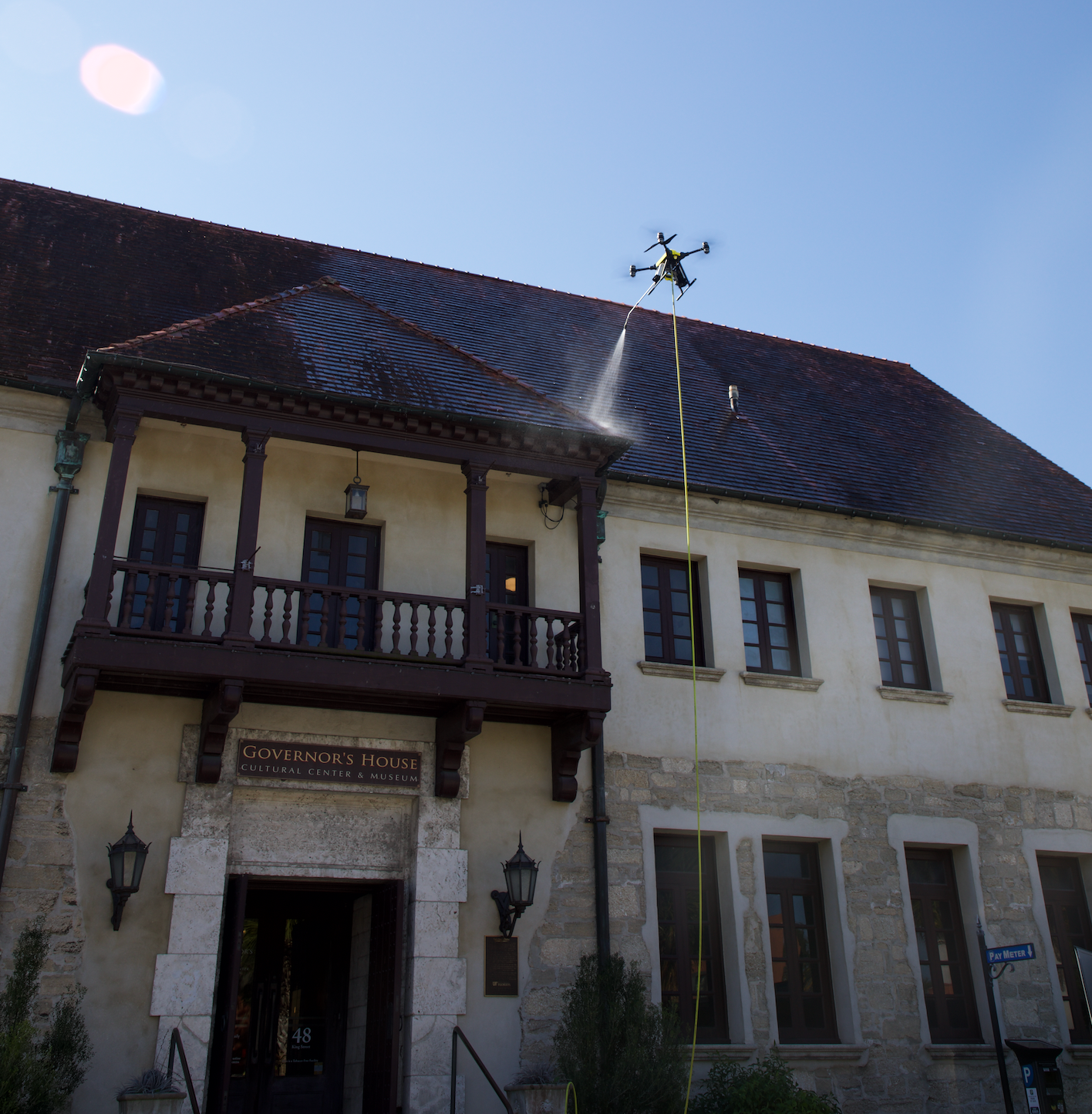
In 2025, the University of Florida, in partnership with the City of St. Augustine, Citra-Shield, and Apellix, used a semi-autonomous Apellix Blue Power Wash Drone to apply a no-rinse, bleach- and chlorine-free exterior cleaner to the clay terracotta tile roof of the Governor's House at 48 King Street, a site continuously occupied by a government building since 1598. The method avoided the two preservation risks specific to historic S-tile roofs: foot traffic on tile crowns and anchoring scaffolding into historic masonry. Three of four roof aspects returned to original clay color over a 12–24 week period; the North face, where lichen exceeded 1 inch, will require follow-up treatments. This case study documents the methodology, observed outcomes, and implications for preservation of comparable structures.
1. Background
The Governor's House — known historically as Government House — has stood at 48 King Street in St. Augustine since 1598, serving as the administrative seat and residence for colonial governors under Spain, Britain, and the United States. The current building is owned by the State of Florida and managed by the University of Florida (UF), which operates it as the Governor's House Cultural Center and Museum and as a teaching site for UF's programs in historic preservation, archaeology, and cultural resource management.
The roof consists of historic clay terracotta S-tiles, which can crack when workers step on the crown (the highest curved part) of the tile or walk quickly across the roof without careful foot placement. Over time, the roof accumulated biological growth typical of warm, humid coastal sites: mold, mildew, algae, and substantial lichen. The cleaning challenge: remove algal growth without damaging the substrate, without anchoring scaffolding into historic masonry and roofing, and without introducing harsh runoff into the adjacent Plaza de la Constitución and the St. Augustine waterfront.
2. Project Partners
University of Florida with the City of St. Augustine. UF manages a portfolio of state-owned historic properties in St. Augustine and provided oversight of the project, including coordinating with the City of St. Augustine. Principal point of contact: Billy Triay, Operations Manager.
Citra-Shield. Citra-Shield supplied its ready-to-use outdoor cleaner, a no-rinse exterior cleaner formulated without bleach, chlorine or lye, designed to break down mold, mildew, algae, and lichen over a weeks-long period without rinsing or mechanical agitation. Point of Contact: Joe Macomber, Founder.
Apellix. Apellix designs and manufactures semi-autonomous industrial drones for power washing, spray painting, and inspection. The cleaning system can reach heights up to 195 feet and deliver pressures up to 4,000 PSI, with operator-adjustable flow rate and spray pattern. Point of Contact: Jeff McCutcheon, Chief Business Officer.
3. Methodology
Treatment area. 15,000 square feet of clay tile roof at various elevations of the Governor's House.
Equipment configuration. Apellix Blue Power Wash Drone operated at a standoff distance of approximately 15 feet from the substrate, delivering Citra-Shield at 150 PSI and a flow rate of 5 GPM through a nozzle producing a fan spray pattern. No water rinse was applied at any stage.
Operator configuration. 3 ground-based operators: one pilot, one chemical-supply technician, one UF documentation lead. No personnel were elevated above ground level during application.
Application protocol. The drone maintained a consistent standoff and traversal speed, with the pilot supervising and adjusting as needed. Application was completed in 6 hours over 1 day. Wind speeds between 5 - 25 mph, within the Apellix operational limits.
Evaluation protocol. UF documented pre- and post-treatment conditions. Treated areas were compared against pre-treatment photographs.
4. Results
Biological growth. At 30 days post-application, treated surface improvement was negligible, which is consistent with Citra-Shield's claim that roof lichen requires 12 - 24 weeks to see visible results. With the passage of time, the East, South and West roof areas showed significant visual improvement with the near-elimination of visible organic materials. East, South and West tiles returned to their original clay coloring, while the North-facing tiles remained covered in lichen over 1 inch thick.
Operational outcomes.
- No scaffolding, aerial lifts, or rope-access systems were used.
- No personnel were elevated above ground level.
- No physical contact between cleaning equipment and the historic structure occurred.
- No bleach, chlorine or lye was discharged to the site or adjacent plaza.
- Total application time was 6 hours, compared with an estimated 40 hours for equivalent scaffold-based cleaning, per contractor estimate.
- The building remained open to the public throughout the project. Sidewalks were temporarily closed when the aircraft was operating directly overhead.
- No foot traffic on the tile roof. The no-contact method eliminates the crown-cracking risk identified in Section 1.
5. Discussion
The project supports four preliminary findings, subject to further evaluation over a longer monitoring period:
First, aerial application of a no-rinse environmentally friendly cleaner like Citra-Shield demonstrated compatibility on this historic roof tiling, pending longer-term monitoring. Because the drone never contacts the surface and no rinse water is forced into the roof or the stone, two of the primary mechanical risks associated with conventional façade cleaning — abrasion and saturation — are severely reduced.
Second, the operational profile changes the labor and risk equation for cleaning fragile historic buildings. The traditional path requires scaffolding or lift access, fall-protected workers, and substantial site preparation. The aerial path reduces this to a small ground crew operating in the immediate vicinity of the building. For owners of tall, fragile, or publicly-accessible historic structures, the safety and disruption profile is materially different.
Third, the methodology is documentable and repeatable. Because each flight produces georeferenced imagery and recorded flight parameters, the same treatment can be re-flown at intervals to monitor recurrence of biological growth, and the same protocol can be transferred to comparable sites.
Fourth, the removal of lichen in excess of 1 inch will require an additional treatment. For future projects, it is recommended to apply a heavier dose of Citra-Shield to shadier North-facing areas with thick lichen growth.
Limitations of this case study include the single-site scope, the monitoring window reported here, and the absence of side-by-side comparison against alternative cleaning methods on matched control areas.
6. Video Documentation
7. Applicability to Other Sites
The combination of aerial application, low-pressure delivery, no-rinse chemistry, and ground-based operations is potentially applicable to a range of structures where conventional cleaning is constrained by height, fragility, public access, or environmental sensitivity. Candidate site types include:
- historic churches and cathedrals; state capitols and courthouses; university halls and campus landmarks; lighthouses, forts, and military monuments; museums and cultural centers; bridges and other transportation infrastructure with sensitive substrates; and large commercial roofs and façades in occupied settings.
Site-specific evaluation of substrate, chemistry compatibility, regulatory constraints, and local conditions remains necessary in every case.
Recommendations for Similar Sites.
- North-facing surfaces in humid coastal climates need scheduled re-treatments;
- Thick lichen (>1 inch) won't be effectively treated with one application;
- Results emerge on a 12–24 week timeline so owners should plan accordingly; and
- Foot-traffic-sensitive roofs are especially good candidates for the method.